

Double Materiality Assessment (DMA) Guide: ESRS, CSRD & Best Practices
Conventional financial reporting addresses a single question: how do external forces affect the company's value? Double materiality addresses two and accords them equal weight.
The first is the outward perspective. What effect does the organisation have on the environment and on people, across both its own operations and its value chain? Greenhouse gas emissions, water use in a water-stressed region, working conditions at a supplier, and the safety of a product in a customer's hands all fall into this category. These are the company's impacts.
The second is the inward perspective. How do sustainability matters affect the business financially, across short, medium, and long-term horizons? A rising carbon price that lifts input costs, a drought that disrupts supply, a reputational event that erodes demand, or a low-carbon product line that opens a new market all belong here. These are the company's risks and opportunities.
Taken together, the two perspectives produce the term EFRAG uses throughout the ESRS: IROs, meaning impacts, risks, and opportunities. A topic qualifies as double material when it is significant from either side. Both lenses are not required; a matter that is significant through either one is material, and therefore reportable.
That single design choice is what distinguishes European sustainability reporting from frameworks such as IFRS S1 and S2, which assess financial materiality alone. It is also what elevates the DMA above a compliance formality: conducted properly, it provides a structured view of the business from the outside in, and that view is of direct interest to the board.
How the CSRD established double materiality as a legal requirement
Double materiality is not a new concept. Its status as a binding obligation is recent, and the path to that status explains why the framework is shaped as it is.
The concept first appeared under the EU's Non-Financial Reporting Directive as guidance rather than a hard requirement. The decisive step came with the Corporate Sustainability Reporting Directive (CSRD), adopted in December 2022, which made the double materiality assessment mandatory and delegated the technical detail to EFRAG. EFRAG subsequently produced the first set of European Sustainability Reporting Standards (ESRS), adopted by the European Commission in 2023.
Those first standards were rigorous and, in practice, demanding. The earliest reporters, the "Wave 1" companies reporting on the financial year 2024, frequently treated the DMA as an exhaustive checklist, working through every topic in the standards and documenting each one in detail. The output tended to be long, dense, and oriented toward demonstrating compliance rather than communicating what genuinely mattered.
The EU responded with a programme of simplification. In February 2025, it launched the Omnibus package and instructed EFRAG to streamline the standards. Following a consultation that drew on more than 700 responses, EFRAG delivered its final technical advice, the Simplified ESRS, on 3 December 2025. Mandatory datapoints fell by approximately 61%, the overall length of the standards was reduced by more than half, and the double materiality assessment was identified as a primary area for simplification.
The legislative scope was revised in parallel. The Omnibus I Directive was approved by the European Parliament in December 2025 and adopted by the Council on 24 February 2026. It raised the CSRD thresholds substantially, taking an estimated 80% of previously in-scope companies out of mandatory reporting.
The position today is straightforward. The CSRD continues to require double materiality, EFRAG continues to define the method, and the assessment remains the gateway to the entire report. The result is a lighter framework, not a less rigorous one.
One point of sequencing is worth keeping in mind. The Simplified ESRS described in this guide reflect EFRAG's technical advice of 3 December 2025; they take legal effect only once the European Commission adopts the implementing Delegated Act, expected during 2026, which will confirm the final application dates. Until that point, companies that remain in scope continue to report under the original ESRS.
The two lenses
Impact materiality (inside-out)
Impact materiality measures how severe and how likely the company's effects on people and the environment are, whether it causes them directly, contributes to them, or is linked to them through a business relationship.
Severity rests on three components: scale (how grave the impact is), scope (how widespread it is), and, for negative impacts, irremediability (how difficult it is to reverse). A potential impact also carries a likelihood, whereas an actual impact already occurring requires no likelihood assessment, because it is real. For impacts on human rights, severity takes precedence over likelihood. Importantly, an impact can be material even where it never appears in the accounts; harm to a community near a supplier site is material on its own terms.
Financial materiality (outside-in)
Financial materiality measures whether a sustainability matter could reasonably affect the company's financial position, performance, cash flows, access to finance, or cost of capital over time. It is assessed on magnitude and likelihood, applying the same discipline used for any business risk or opportunity.
The two lenses often converge on the same topic from different directions. Climate is the clearest example: the company's emissions constitute an impact, while the low-carbon transition represents a financial risk and opportunity. These are related, but each is assessed and documented separately. Combining them into a single score is among the most common errors identified in assurance, because it obscures which lens made the topic material.
Approaches: top-down or bottom-up?
This is the question most reporting teams now consider first, and the area in which practice has shifted most significantly.
A bottom-up assessment begins with the full universe of sustainability topics and works inward, testing each against the business to determine what is relevant. It is exhaustive and defensible, but it is also slow, and it tends to generate documentation for topics that were never likely to be material.
A top-down assessment begins with the company. The team maps the business model, strategy, value chain, and stakeholders, then derives the topics and IROs that genuinely arise from that picture. Deeper analysis is reserved for the issues most likely to result in material disclosures.
Under the original ESRS, the bottom-up route predominated. The simplified ESRS deliberately establishes top-down as a valid starting point, organised around an information materiality filter: where a topic will not generate information capable of influencing a reader's decisions, it does not warrant exhaustive evidence. EFRAG situates this within a fair presentation principle drawn from financial reporting, under which the objective is a faithful and balanced picture rather than a complete checklist. During the public consultation, this shift was repeatedly identified as the single most effective simplification in the revision.
For most companies, the pragmatic route is a top-down spine supported by bottom-up validation: the shortlist is built from business reality, then tested against the standards and sector peers to ensure that nothing material is omitted. A top-down approach keeps the assessment focused, while bottom-up validation keeps it complete.
Setting thresholds and choosing metrics
A materiality threshold is the line that separates "material, and therefore disclosed" from "not material, and therefore omitted." No figure is prescribed by the regulator, and this is deliberate. Companies define their own thresholds, but they must be able to justify them.
Thresholds may be qualitative or quantitative, and a sound assessment generally employs both. A quantitative threshold might score severity and likelihood on a defined scale, treating results above an agreed cut-off as material. A qualitative threshold relies on reasoned judgment, which is essential for impacts on human rights or ecosystems that resist precise quantification. Whichever approach is applied, the rationale should be documented, since implicit and undocumented thresholds are a recurring assurance finding.
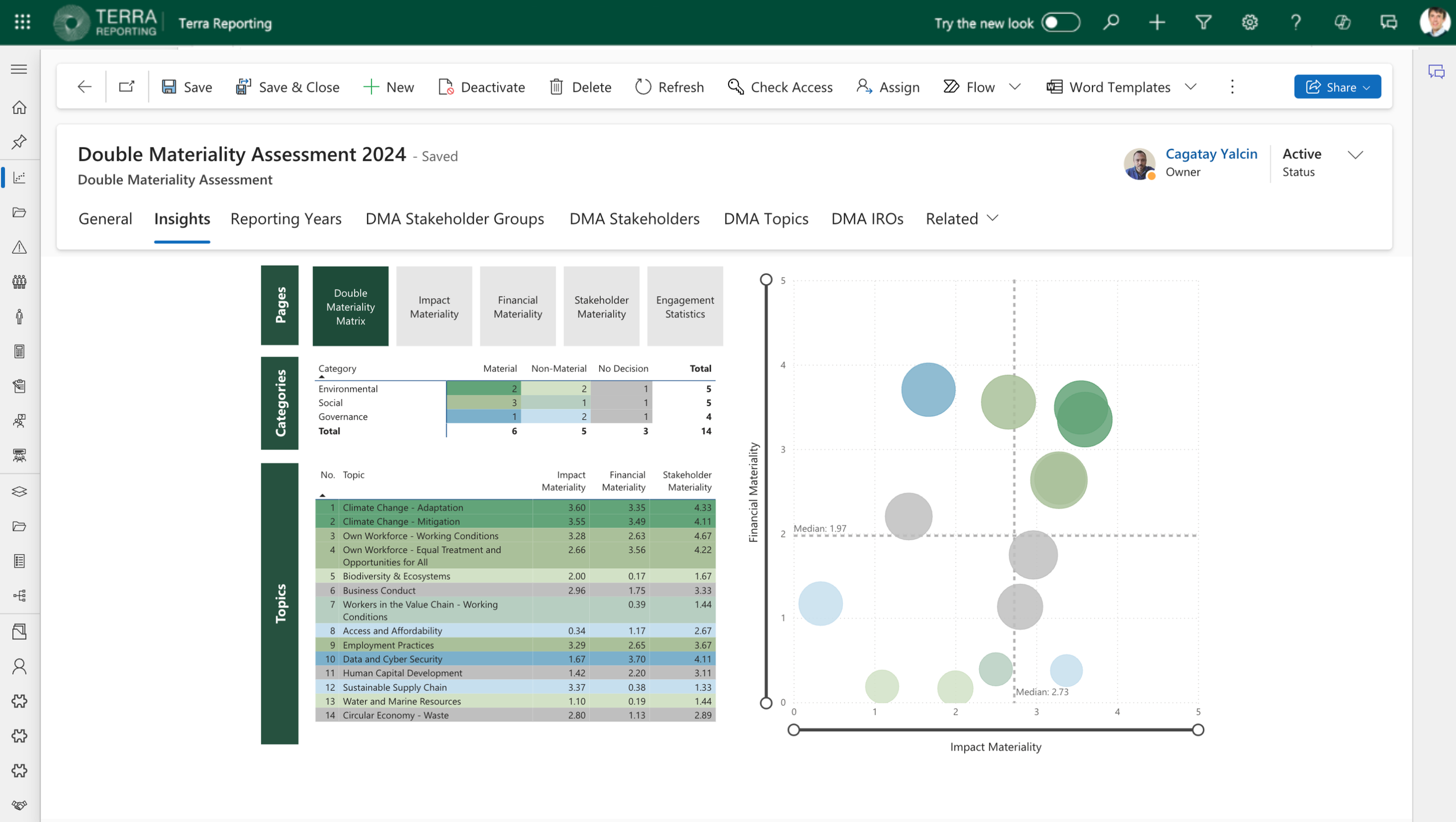
The principal output is typically a materiality matrix, often presented as a heatmap, with impact materiality on one axis and financial materiality on the other. It should be treated as a means of communication rather than the assessment itself. The reasoning behind each IRO is what an auditor will examine, not the position of a given entry on the grid.
With respect to metrics, restraint is more valuable than volume. The Simplified ESRS permits reporting at the topic, sub-topic, or IRO level and removed the most granular sub-sub-topic layer entirely. Every metric should be linked to a material IRO; a datapoint with no connection to a material finding rarely belongs in the report.
The five steps of a double materiality assessment
In line with the top-down logic of the Simplified ESRS, a defensible DMA proceeds through five steps.
Map the context
Start with the business, not the standards. Document the business model, strategy, full value chain, geographies, and stakeholders — employees, communities, customers, suppliers, and investors. This map is the raw material for everything that follows and is what makes a top-down assessment possible.
Identify impacts, risks, and opportunities
Derive the IROs from that context: where the business affects people and the environment, and where sustainability matters affect its finances. Use the ESRS topic list and sector patterns as prompts, but let actual operations drive the list. Engage stakeholders — they often surface impacts internal teams miss. Aim for a focused, evidence-based longlist, not a catalogue of every issue.
Assess and score each IRO
Apply both lenses. Score impacts on severity (scale, scope, irremediability) and likelihood; score risks and opportunities on financial magnitude and likelihood. Keep the two assessments separate so it stays clear which lens drove each result. Apply the defined thresholds, and record the reasoning behind borderline calls — those are the most likely to be challenged.
Determine materiality and validate
Confirm material matters, apply the information materiality filter, and validate the conclusions — externally with stakeholders or experts, and internally through sign-off. The ESRS require the administrative, management, and supervisory bodies to oversee the material IROs, so governance approval is part of the standard, not a formality.
Report and integrate
Disclose the assessment under ESRS 2 IRO-1 and IRO-2, map each material IRO to its topical standard, and explain the link to business model and strategy under ESRS 2 SBM-3. Maintain a complete audit trail throughout. Then feed the results into strategy, policies, and targets — an assessment that informs nothing beyond the report is a missed opportunity.
ESRS 2 · IRO-1 · IRO-2 · SBM-3A full DMA no longer needs to be repeated annually. It is refreshed when a significant change occurs — an acquisition, entry into a new market, or a material shift in the risk landscape. Between refreshes, the assessment is reviewed, not rebuilt.
What changed in 2026, and what it means for your DMA
Where a team has already conducted a double materiality assessment under the original ESRS, that work is not obsolete. It does, however, warrant review against the revised rules. The four shifts that matter most are set out below.
| Dimension | Original ESRS | Simplified ESRS (from 2026) |
|---|---|---|
| Scope | Original ESRS“Two of three” test: 250 employees, EUR 25 million balance sheet, EUR 50 million turnover | Simplified ESRSAbove 1,000 employees and EUR 450 million net turnover; many former Wave 1 companies fall out of mandatory scope |
| Method | Original ESRSPredominantly bottom-up, working through the full topic universe | Simplified ESRSTop-down by default, organised around an information materiality filter |
| Granularity | Original ESRSTopic, sub-topic, and sub-sub-topic detail | Simplified ESRSSub-sub-topics removed; topic-level or aggregate reporting permitted |
| Cadence | Original ESRSFull assessment effectively repeated each cycle | Simplified ESRSRefreshed on significant change; reviewed, not rebuilt, in between |
On timing, companies that remain in scope should note the transitional arrangements. Those that have fallen out of mandatory scope may qualify for a transitional exemption covering financial years 2025 and 2026, though this is an option each Member State may choose to grant rather than an automatic entitlement, so the position depends on the country in which the company reports. The new ESRS requirements apply from the financial year 2027, with optional early application for 2026.
The strategic implication is significant. The companies that remain in scope are, by definition, the largest and most complex, which raises the value of a precise, well-reasoned DMA rather than diminishing it. The simplification removed procedural burden; it did not remove the need for judgment.
What if you are no longer in scope?
The revised thresholds mean that a large share of companies that prepared for CSRD, including many former Wave 1 reporters, are no longer required to report. If that describes your organisation, the assessment does not become irrelevant. It changes from an obligation into a choice, and for several reasons, the choice often favours continuing in a lighter form.
The first reason is the value chain. Companies that remain in mandatory scope are the largest and most complex, and they depend on data from their suppliers and partners to complete their own disclosures. If you sell to an in-scope customer, you are likely to receive requests for sustainability information regardless of your own reporting status. A proportionate DMA tells you which topics those requests will concern and prepares you to answer them. The Omnibus reforms introduced a value chain cap that limits what large reporters can require from smaller undertakings, so the burden is intended to be contained, but the requests do not disappear.
The second reason is voluntary reporting. EFRAG developed a voluntary standard for SMEs, the VSME, designed to give smaller companies a proportionate framework rather than the full ESRS. It offers a structured way to disclose what matters to lenders, investors, and customers without the weight of mandatory reporting, and a focused double materiality assessment is a sensible foundation for it.
The third reason is internal. The outside-in view that a DMA produces is useful to a board, whether or not a regulator requires it. It surfaces risks in the supply chain, exposure to transition costs, and opportunities in lower-carbon products, all of which inform strategy. An assessment conducted once, kept proportionate, and refreshed when the business changes is a low-cost source of that view.
The practical recommendation for an out-of-scope company is therefore to scale the effort to the purpose. A full, assurance-grade assessment is no longer necessary. A lighter top-down assessment, documented well enough to answer customer and financing questions, usually is.
Common pitfalls to avoid
The first wave of CSRD reports revealed a consistent set of errors. Avoiding them addresses much of what separates a weak assessment from a defensible one.
Treating the DMA as a checklist: Mapping directly from ESRS topics to disclosures, without genuine IRO analysis, produces boilerplate of limited value to readers.
Combining the two scores: Merging impact and financial materiality into a single figure obscures which lens made a topic material. The two should remain distinct.
Vague thresholds: Setting cut-offs implicitly, with no documented rationale, is among the most common causes of an assurance finding.
Neglecting the value chain: Concentrating on one's own operations and under-investigating suppliers and downstream use overlooks where many of the most severe impacts arise.
Omitting stakeholder input: Relying solely on internal opinion leaves blind spots that affected groups would have identified.
Insufficient governance: Failing to bring material IROs to the board breaches an explicit ESRS requirement.